Mostrando entradas con la etiqueta energía. Mostrar todas las entradas

sábado, 7 de diciembre de 2019

El principio de la Vida. The principle of Life.


Mariano Giacobone

Durante siglos la ciencia ha estado buscando el principio de la vida en las raíces de la materia. Evidentemente esta búsqueda ha sido infructuosa.


For centuries science has been looking for the principle of life in the roots of matter. Obviously this search has been unsuccessful.

Descarga la versión completa en PDF: click aquí

Download the full PDF version: click here


lunes, 18 de noviembre de 2019

Manual de los espíritus libres

por el Dr. Mariano Giacobone.

"...Para recuperar tu verdadera identidad y liberarte a ti mismo, no solo es suficiente con desearlo, es necesario un método."

Cliquéa aquí para descargar el archivo.

Manual of free spirits

English versionclick here


lunes, 7 de enero de 2019

El arte del Aikido. The art of Aikido.

Por M. Giacobone sensei

English Version at bottom
Aikido es el arte de la paz.
El arte de la paz es transformación y equilibrio.
El equilibrio aporta armonía y belleza.

"Todas las cosas, materiales y espirituales, se originan de la misma fuente y están relacionadas
como si fueran una sola familia. El pasado, presente, y futuro están todos contenidos en la
fuerza vital. El universo emergió y se desarrollo de una sola fuente, y nosotros hemos
evolucionado a través del proceso optimo de armonización y unificación." O´Sensei

Aikido es el camino que te permite unirte a la energía universal.
Aikido es el arte de la transformación.
Aikido es verdadero Budo. Es el camino de la paz, la armonía y el entendimiento entre los seres.

"Uno no necesita edificaciones, dinero, poder o status para practicar el Arte de la Paz. 
El Cielo está aquí mismo donde te encuentras parado, y ese es el lugar para entrenar." O´Sensei

El arte de la transformación funciona como una alquimia, toma lo malo y lo cambia en bueno, aporta equilibrio y armonía ahí donde hace falta. Une y pacifica.

La vida es cambio y crecimiento.

"Si nosotros dejamos de crecer, técnicamente y espiritualmente, entonces somos tan buenos como un muerto. El Arte de la paz es una celebración de la unificación del cielo, la tierra, y la humanidad. Todo esto es verdadero, bueno, y hermoso." O´Sensei

Todo en el cielo y la tierra respira. El universo respira. Unite a esta respiración y te volverás uno con el universo.
Cuando inhalas el universo entra dentro tuyo. Absórbelo, intégralo a tu ser.
Exhala lenta y profundamente, devuelve al universo esa energía y esa información, ahora transformadas.
La respiración es el hilo que amarra a toda la creación.

Aikido desarrolla y fortalece la respiración. Es Kokyu Rokyu, el poder de la respiración.
Sin respiración no es posible la vida.
Sin respiración no hay movimiento ni transformación.
Sin respiración no hay Aikido.


La armonía y el equilibrio se originan en el fluir de las cosas.
El ritmo y la belleza son la clave.

Observa a la Madre Naturaleza y reflexiona.
Aikido representa 4 cualidades de la naturaleza: Duro como el diamante, flexible como el sauce, suave y fluido como el agua, vacío como el espacio.

Las técnicas de Aikido emergen del principio del círculo.
La vida es movimiento circular.

Todos los principios del cielo y la tierra viven dentro de ti.
Eres la manifestación de 2 fuerzas opuestas y complementarias, Yin y Yang, que son la fuerzas esenciales de toda la creación.

Ocho fuerzas sostienen a la creación: Movimiento y quietud. Solidificación y fluidez.
Expansión y contracción. Unión y Separación.

Tu vida misma es la expresión de estas fuerzas.

"Crea cada día nuevamente vistiéndote con el cielo y la tierra, bañándote con sabiduría y amor, y situándote en el corazón de la Madre Naturaleza.
Siempre mantén tu mente tan brillante y clara como el vasto cielo, el gran océano, y el pico más alto, vacío de todo pensamiento. Siempre mantén tu cuerpo lleno de luz y calor. 
Llénate a ti mismo con el poder de la sabiduría y de iluminación.
Tan pronto como te inquietes con lo “bueno” y lo “malo” de tus compañeros, te creas una abertura en tu corazón para que entre la malicia. Probar, competir, y criticar a otros te debilita y te derrota."
O´Sensei.


English Version


By M. Giacobone sensei


Aikido is the art of peace.
The art of peace is transformation and balance.
Balance brings harmony and beauty.

"All things, material and spiritual, originate from the same source and are related as if they were one family. The past, present, and future are all contained in the vital force. The universe emerged and developed from a single source, and we have evolved through the optimal process of harmonization and unification." O'Sensei

Aikido is the path that allows you to join the universal energy.
Aikido is the art of transformation.
Aikido is true Budo. It is the path of peace, harmony and understanding between beings.

"You do not need buildings, money, power or status to practice the Art of Peace.
Heaven is right here where you stand, and that's the place to train." O'Sensei

The art of transformation works like an alchemy, takes the bad and changes it into good, brings balance and harmony where it is needed. Unite and pacify.

Life is change and growth.

"If we stop growing, technically and spiritually, then we are as good as dead." The Art of Peace is a celebration of the unification of heaven, earth, and humanity, all of which is true, good, and beautiful." O'Sensei

Everything in heaven and earth breathes. The universe breathes. Join this breath and you will become one with the universe.

When you inhale the universe, it enters inside you. Absorb it, integrate it with your being.
Exhale slowly and deeply, return to the universe that energy and that information, now transformed.

The breath is the thread that binds all creation.

Aikido develops and strengthens breathing. It's Kokyu Rokyu, the power of breathing.

Without breathing, life is not possible.

Without breathing, there is no movement or transformation.

Without breathing there is no Aikido.
Harmony and balance originate in the flow of things.

Rhythm and beauty are the key.

Observe Mother Nature and reflect.

Aikido represents 4 qualities of nature: Hard as diamond, flexible as willow, smooth and fluid as water, empty as space.

Aikido techniques emerge from the principle of the circle.

Life is circular movement.

All the principles of heaven and earth live within you.

You are the manifestation of  2 opposing and complementary forces, Yin and Yang, which are the essential forces of all creation.

Eight forces sustain creation: Movement and stillness. Solidification and fluidity. Expansion and contraction. Union and Separation.

Your life itself is the expression of these forces.

"Create each day again by dressing yourself with heaven and earth, bathing yourself with wisdom and love, and placing yourself in the heart of Mother Nature.
Always keep your mind as bright and clear as the vast sky, the great ocean, and the highest peak, empty of all thought. Always keep your body full of light and heat.
Fill yourself with the power of wisdom and enlightenment.
As soon as you worry about the "good" and the "bad" of your companions, you create an opening in your heart so that malice can enter. Testing, competing, and criticizing others weakens and defeats you." O'Sensei.


viernes, 16 de marzo de 2018

¿De qué estamos hechos? What are we made of?

English version at the bottom


La dura vida de la partícula 

Nuestros conceptos acerca de lo que es material o inmaterial se basan en lo que percibimos por medio de los sentidos.

De acuerdo con las descripciones de la física clásica, existen diferencias entre una onda y una partícula. La partícula ocupa un lugar en el espacio y tiene masa, o sea, materia. Mientras que una onda se extiende en el espacio, perturbándolo, caracterizándose por tener una velocidad definida y masa nula, es inmaterial.

El término “partícula” se encuentra ampliamente en nuestra lenguaje: partículas de polvo, partículas elementales, partículas gramaticales, particularmente… 

Se define a la partícula como la menor porción de materia de un cuerpo que conserva sus propiedades químicas. Pueden ser átomos, iones, moléculas o partículas subatómicas (protón, neutrón, electrón, etc).

La partícula nos trae referencia a algo material, concreto o corpóreo, una entidad con límites definidos: es decir, algo “particular”.

Una onda consiste en la propagación de una perturbación de alguna propiedad de un medio (densidadpresióncampo electromagnético), a través del mismo medio. Esto implica el transporte de información y energía pero no de materia. El medio perturbado puede ser de naturaleza diversa como el aire (sonido), el agua (olas), la tierra (ondas sísmicas) e incluso inmaterial como el vacío (luz). 


ondas gravitacionales

Podemos diferenciar sin dificultad una partícula de una onda.
Si observamos el oleaje en un estanque no tiene nada que ver con una piedra (a menos que la piedra sea la causa de la ondulación). Nos resulta muy difícil, por no decir imposible, en términos convencionales y ordinarios, considerar que en realidad se trata del mismo fenómeno. La diferencia reside en que solo podemos detectar uno de los dos aspectos. Si percibimos la partícula no podemos ver su naturaleza ondulatoria y si observamos una onda, su naturaleza corpuscular se esconde.

Es más, la idea lógica que tenemos de ambas cosas es mutuamente excluyente: un cuerpo no es una onda insustancial y una onda que se propaga no es material.

He aquí la fuente de muchos errores de percepción y el motivo de porque tenemos la tendencia a considerar solo la realidad “material”. 
No tenemos problema en reconocernos como cuerpos físicos. Incluso asumimos las limitaciones impuestas, dando por sentado que cada uno y todo lo demás, existen por separado. Al no percibir nuestra naturaleza ondulatoria, entrelazada y conectada con todo, la realidad que proyectamos es mas densa, estrecha y con menos posibilidades. 

La cuestión es la siguiente: cuando llamamos a algo “partícula” u “onda” no estamos definiendo lo que es, sino como se comporta ante una situación determinada.

La verdadera naturaleza de las cosas no es algo que podamos experimentar directamente al interactuar con ellas, ya que nuestros sentidos tienden a “particularizar” y a limitar la percepción porque así están diseñados.

El pensamiento, que es una onda (vibración u oscilación) que transporta energía e información, se expresa en el nivel consciente de forma particular y secuencial. La onda indeterminada de múltiples posibilidades de los niveles subconscientes, se transforma (colapsa) y se manifiesta 
en el nivel consciente como partícula de conocimiento, es decir, como una experiencia determinada. 
No es correcto decir que las cosas son “ondas que a veces se convierten en partículas” o “partículas que a veces se comportan como ondas”, aunque parece más acertado, es una percepción errónea de las cosas.


¿Qué son las cosas, partículas materiales u ondas de posibilidades? 

Las dos al mismo tiempo, pero solo puede manifestarse una a la vez.

La influencia de la conciencia es determinante 

Si decidimos observar partículas no veremos su naturaleza ondulatoria y viceversa.

Y esto sucede porque hay algo más profundo en la naturaleza de las cosas que aún no percibimos.

Nuestro cerebro está condicionado para detectar y proyectar una realidad material, seguramente por esta causa consideramos casi exclusivamente el aspecto corpóreo y “particular” más que la interconexión, la interdependencia y por consiguiente las posibilidades de lo que percibimos.

La materia es vibración 

Sabemos que la materia es en realidad energía condensada o cristalizada, y que los pensamientos son energía e información y por lo tanto pueden materializarse.

Energía y materia son equivalentes, esto ya ha sido demostrado por Einstein hace 1 siglo y por los chinos hace más de 20 siglos. 


Cuerpo y mente no son de naturaleza diferente y no existen por separado.

Los pensamientos son ondas de información y energía que perturban el campo, transformándose en partículas materiales, generando y modelando al cuerpo físico.

Por cierto, no hay que confundirse, cuando decimos que la materia vibra, no significa que las partículas, como los electrones, están vibrando alrededor de un punto de equilibrio. Las partículas no oscilan: las partículas son en si mismas la oscilación. Ambas son lo mismo, no es una cosa (la partícula) efectuando una acción (la oscilación).

La vibración es la masa

Nuestra manera ordinaria de percibir la realidad es dualista, y esto es debido a que los procesos algorítmicos conscientes en el neocórtex. son binarios y secuenciales: 0/1, apagado/encendido, acierto/error. O uno o lo otro. No puede ser 0 y 1 al mismo tiempo, como sucede en el procesamiento en paralelo de la información en los niveles preconscientes, donde la onda de posibilidades se encuentra en estado de superposición cuántica, presentando simultaneidad y coherencia (puede ser 00, 01,10 ó 11)

Solo podemos tomar una decisión a la vez. En el nivel consciente de la realidad cotidiana, los objetos y sucesos, se manifiestan mostrando un solo aspecto, que es precisamente el que pueden captar nuestros sentidos.

¿Qué somos entonces? ¿Ondulaciones insustanciales o cuerpos sólidos?

Nuestros conceptos de cuerpo y vibración se basan en la información que obtenemos a través de los sentidos. Son términos con una gran antigüedad y bien enraizados en nuestra cultura, y determinan la manera que tenemos de percibir las cosas. 


A pesar de que todo el mundo tiene claro lo que es la materia y lo que es una onda: nadie confunde un ladrillo con un rayo de luz. La primera idea que tenemos de ambas cosas es mutuamente excluyente: si es sólido no puede ser no sólido. Decir que algo es partícula y onda nos parece similar a decir que algo es azul y no es azul a la vez. Y ahí está el primer obstáculo a superar. 


La cuestión no es sólo que esa idea es falsa, sino que es contraria a la realidad. Es decir: “partícula” y “onda” no son lo mismo que “azul” y “no azul”, y no porque sean características independientes que a la vez puedan ser ciertas, como “azul” y “oscuro”, estas deben ser necesariamente ciertas al mismo tiempo. Algo así como “azul” y “blue”. La misma cosa con nombres distintos. Si entendiste esto, has superado ese primer obstáculo y estás listo para saltar sobre el segundo, que es algo más sutil: lo de “azul” y “blue” es sólo una primera aproximación a la realidad.

Llamamos a las cosas ondas o partículas porque, cuando interaccionamos con ellas, lo hacemos de modos específicos. Estamos dando nombres a la manera en la que esas entidades reaccionan, no a lo que son en realidad.

Podríamos también decir: “El universo está formado por ondículas que en determinadas circunstancias se comportan de cierta manera, a la que hemos llamado tradicionalmente “onda”, y en otras se comportan de una manera diferente, a la que llamamos “partícula”. Pero las cosas no son ondas ni partículas: son ondículas (o partondas, como prefieras).

La cuestión es que algunas ondículas son muy ondas y hacen falta experimentos muy específicos para revelar su comportamiento corpuscular y otras ondículas (o partondas) son muy particulares y no muestran fácilmente su naturaleza ondulatoria.

Nuestro cuerpo físico tiene solidez aparente porque está hecho de una infinitud de átomos que vibran a una altísima frecuencia.

Esencialmente son oscilaciones de la misma cosa. Esta “cosa” o entidad (para darle un nombre) es la conciencia

El sustrato de todo lo que existe es la conciencia.

La conciencia provoca el movimiento de la información y la energía, y a causa de esto la masa se condensa creando el mundo físico.

La diferencia la hacen las categorías humanas y la necesidad de describir con palabras y fórmulas el universo en el que vivimos.

Son nuestros órganos sensoriales los que captan la información de una determinada manera, y como los sentidos, por su diseño y por educación, perciben una realidad “particular”, interpretamos y creamos siempre una realidad física (generalmente la misma), aparentemente sólida y duradera. 

El problema con el que se topa la ciencia es que no siempre las descripciones se ajustan a lo “real”. El universo es lo que es y nuestras descripciones y conceptos nunca podrán explicarlo con exactitud en su totalidad.

Bohr formuló en la interpretación de Copenhague lo que se conoce como el principio de complementariedad, el cual establece que ambas descripciones, la ondulatoria y la corpuscular, son necesarias para comprender el mundo cuántico.

Einstein y Bohr
 Bohr había señalado el hecho que mientras en la física clásica un sistema de partículas en dirección funciona como un aparato de relojería, independientemente de que sean observadas o no, en física cuántica el observador (la conciencia) interactua con el sistema de tal forma que el sistema no puede considerarse como una existencia independiente. 

El sujeto y el objeto son uno

En los niveles fundamentales de la realidad, la observación altera de forma incontrolada la evolución del sistema. 

Es erróneo pensar, en el mundo de las partículas, que medir es revelar propiedades que estaban en el sistema con anterioridad. Y esto sucede porque los fotones de luz del observador impactan e interfieren con los electrones, intercambiando energía e información y cambiando el estado del sistema.

Esta pérdida de coherencia cuántica es lo que se llama: reducción o colapso de la función de onda

El universo no manifestado, de infinitas posibilidades superpuestas y entrelazadas, se manifiesta al reducirse o colapsar en una sola (de las tantas) experiencia “particular”.

Promediando los años 20, en los principios de la física cuántica, Heisenberg (junto a Max Born y otros) demostró con su mecánica matricial que no se puede saber con exactitud la posición y el momento de una partícula. Cuanto más sabemos sobre la posición de un electrón, por ejemplo, menos datos disponemos sobre su velocidad. Cuanto más averiguamos sobre su movimiento más borrosa se vuelve su ubicación. 

Heisenberg
La relación de incertidumbre de Heisenberg refleja una vez más esta dualidad de la naturaleza, aunque en este caso referida a otras propiedades físicas de la materia, como la posición y el momento. Si diseñas un experimento que muestre una cosa, la complementaria está “oculta”. Al menos, en el caso de la relación de indeterminación, no se trata de una elección binaria sí/no, más bien tiene que ver con el grado de manifestación: cuanto más te fijas en una cosa, más borrosa se vuelve su complementaria. 

Si elegimos medir con precisión la posición de una partícula la forzamos a presentar mayor indeterminación en su momento, y viceversa. De la misma forma, si elegimos un experimento para medir propiedades ondulatorias se eliminan peculiaridades corpusculares. Ningún experimento puede mostrar ambos aspectos, el ondulatorio y el corpuscular, simultáneamente.

Debido a esta “particularidad” de la observación y de la percepción, captamos solo el lado material de la realidad. Como un iceberg, del que solo vemos la menor parte (solo la que muestra).


Nuestra mirada particulariza al universo, lo vuelve físico y corpóreo. 
La ilusión de los sentidos lo vuelve material.

“Lo esencial es invisible a los ojos” (Saint Exupery)


¿Qué tiene en común el observador y la partícula? 

Ambos son en esencia lo mismo: movimiento de la conciencia.

Esta es la razón por la cual nos referimos a las fases ondulatorias de las partículas no como ondas materiales, sino como ondas de probabilidades. Esta capacidad de las partículas elementales para existir en más de un lugar al mismo tiempo nos revela algunas cuestiones profundas de la naturaleza de nuestro mundo físico.

¿Cuál es el rol que desempeña la conciencia o el observador, en todo esto?

Si lo relacionamos con el Principio de Incertidumbre (por el cual no tiene sentido hablar de la trayectoria de una partícula en el espacio, y la capacidad de la misma de estar en más de un sitio al mismo tiempo) resulta carente de sentido pensar que dicha partícula sea algo real si no existe un observador humano.

Antes de que el electrón del experimento haya dejado su marca en la pantalla (cuando hacemos la observación), no podemos determinar con precisión sus características, es más bien una onda de probabilidades que se aparece y desaparece y parece existir al mismo tiempo en todos sus trayectos posibles.

Por esto Heisenberg expresó: “no podemos conocer el presente en todos sus detalles”.
Hay una cierta probabilidad de que la partícula se encuentre en un lugar determinado, pero en principio podría estar en cualquier parte. La interacción con el observador modifica su comportamiento.

Si los microscópicos bloques de construcción de los objetos materiales no poseen las características de los objetos materiales. Si 
en esencia la materia es más una nube de probabilidades que algo fijo y concreto ¿qué tan sólido es el mundo en el qué vivimos? ¿y nuestro cuerpo, de que estamos hechos en realidad? 

Cuando nos hacemos este tipo de preguntas inevitablemente nuestra percepción de las cosas y de nosotros mismos cambia, se expande, gana en profundidad e información.

Esto más que una comprobación científica es un hecho espiritual.

El cuerpo está completamente descentralizado. No hay una central, sino que hay varias centrales gestionando la información en diferentes niveles, incluso extracorporales.

¿Pero qué son entonces las cosas?

Posibilidades. Sucesos que se transforman en una realidad material provisoria.

¿Y cómo podemos percibir la interconexión y las posibilidades, en lugar de colapsar siempre en la misma realidad material predeterminada?

Trascendiendo la percepción ordinaria de los sentidos y la mente individual. 

La conciencia se materializa con facilidad, dependiendo del nivel de energía e información que contenga.


La revolución de los sentidos 

Reprogramar la actividad cerebral desde la mente consciente es muy difícil, ya que por su nivel de energía y configuración, tiene la tendencia a colapsar siempre en una realidad material determinada. 

Formatear el disco eliminando la información falsa y tendenciosa es fundamental.

El cerebro se reconfigura gracias a su capacidad plástica y a la flexibilidad de sus conexiones. Esto
 incrementa la potencia para procesar información y optimiza su funcionamiento.  
Para esto debe volver a cero, equilibrar su actividad mediante la calma mental y el reposo sensorial. Las posturas que adopta el cuerpo son fundamentales.

No hay separación entre la mente y el cuerpo. Son diferentes expresiones de una misma verdad.

Cuerpo y espíritu en unidad manifiestan nuestra verdadera naturaleza, naturalmente y de forma inconsciente.

Cuando la conciencia se libera de los límites de la percepción ordinaria, se expande y cambia su dimensión, afectando indefectiblemente al sustrato físico. 


Estamos hechos del mismo material que el cielo, la tierra...y los sueños.


Mariano Giacobone sensei


..................................................

The hard life of the particle

Our concepts about what is material or immaterial are based on what we perceive through the senses.

According to the descriptions of classical physics, there are differences between a wave and a particle. The particle occupies a place in space and has mass, that is, matter. While a wave extends into space, disturbing it, characterized by having a defined speed and null mass, it is immaterial.

The term "particle" is widely found in our language: dust particles, elementary particles, grammatical particles, particularly ...

The particle is defined as the smallest portion of matter in a body that retains its chemical properties. They can be atoms, ions, molecules or subatomic particles (proton, neutron, electron, etc).

The particle brings us reference to something material, concrete or corporeal, an entity with defined limits: that is, something "particular".


A wave consists in the propagation of a disturbance of some property of a medium (density, pressure, electromagnetic field), through the same medium. This implies the transport of information and energy but not matter. The disturbed medium can be diverse in nature such as air (sound), water (waves), earth (seismic waves) and even immaterial as vacuum (light).

We can differentiate without difficulty a particle of a wave.

If we observe the swell in a pond it has nothing to do with a stone (unless the stone is the cause of the ripple). We find it very difficult, not to say impossible, in conventional and ordinary terms, to consider that it is really the same phenomenon. The difference is that we can only detect one of the two aspects. If we perceive the particle we can not see its wave nature and if we observe a wave, its corpuscular nature is hidden.

Moreover, the logical idea we have of both is mutually exclusive: a body is not an insubstantial wave and a wave that propagates is not material.

Here is the source of many errors of perception and the reason why we tend to consider only the "material" reality.

We have no problem in recognizing ourselves as physical bodies. We even assume the imposed limitations, assuming that each and everything else exists separately. By not perceiving our wave nature, intertwined and connected with everything, the reality we project is denser, narrower and with fewer possibilities.


The question is this: when we call something "particle" or "wave" we are not defining what it is, but how it behaves in a given situation.

The true nature of things is not something that we can directly experience when interacting with them, since our senses tend to "particularize" and limit perception because they are so designed.

Thought, which is a wave (vibration or oscillation) that transports energy and information, is expressed in the conscious level in a particular and sequential way. The indeterminate wave of multiple possibilities of the subconscious levels, is transformed (collapses) and manifests itself in the conscious level as a particle of knowledge, that is, as a determined experience.

It is not correct to say that things are "waves that sometimes become particles" or "particles that sometimes behave like waves", although it seems more accurate, it is an erroneous perception of things.

What are things, material particles or waves of possibilities?

Both at the same time, but it can only manifest one at a time.

The influence of conscience is decisive

If we decide to observe particles we will not see their wave nature and vice versa.

And this happens because there is something deeper in the nature of things that we still do not perceive.

Our brain is conditioned to detect and project a material reality, surely for this reason we consider almost exclusively the corporeal and "particular" aspect rather than interconnection, interdependence and therefore the possibilities of what we perceive.

Matter is vibration

We know that matter is actually condensed or crystallized energy, and that thoughts are energy and information and therefore can materialize.


Energy and matter are equivalent, this has already been demonstrated by Einstein 1 century ago and by the Chinese more than 20 centuries ago.

Body and mind are not of a different nature and do not exist separately.

Thoughts are waves of information and energy that disturb the field, transforming themselves into material particles, generating and modeling the physical body.

By the way, do not get confused, when we say that matter vibrates, it does not mean that particles, like electrons, are vibrating around a point of equilibrium. The particles do not oscillate: the particles are in themselves the oscillation. Both are the same, it is not a thing (the particle) performing an action (the oscillation).

The vibration is the mass

Our ordinary way of perceiving reality is dualistic, and this is due to the conscious algorithmic processes in the neocortex. they are binary and sequential: 0/1, off / on, right / wrong. Or one or the other. It can not be 0 and 1 at the same time, as in the parallel processing of information at preconscious levels, where the wave of possibilities is in a state of quantum superposition, presenting simultaneity and coherence (it can be 00, 01,10 or 11)

We can only make one decision at a time. At the conscious level of everyday reality, objects and events manifest themselves by showing only one aspect, which is precisely what our senses can grasp.

What are we then? Insubstantial ripples or solid bodies?


Our concepts of body and vibration are based on the information we obtain through the senses. They are terms with a great antiquity and well rooted in our culture, and determine the way we perceive things.

Although everyone is clear about what is matter and what is a wave: no one mistakes a brick with a ray of light. The first idea we have of both is mutually exclusive: if it is solid, it can not be non-solid. To say that something is particle and wave seems similar to saying that something is blue and not blue at the same time. And there is the first obstacle to overcome.

The question is not only that this idea is false, but that it is contrary to reality. That is to say: "particle" and "wave" are not the same as "blue" and "not blue", and not because they are independent characteristics that at the same time can be true, such as "blue" and "dark", they must be necessarily certain at the same time. Something like "blue" and "blue". The same thing with different names. If you understood this, you have overcome that first obstacle and are ready to jump on the second, which is something more subtle: the "blue" and "blue" is only a first approximation to reality.

We call things waves or particles because, when we interact with them, we do it in specific ways. We are giving names to the way in which those entities react, not to what they really are.

We could also say: "The universe is formed by wavelets that in certain circumstances behave in a certain way, which we have traditionally called" wave ", and in others behave in a different way, which we call" particle ". But things are not waves or particles: they are wavicles. That is, both at the same time.

The point is that some wavicles are very waves and very specific experiments are needed to reveal their corpuscular behavior and other wavicles are very particular and do not easily show their wave nature.

Our physical body has apparent solidity because it is made of an infinity of atoms that vibrate at a very high frequency.

Essentially they are oscillations of the same thing. This "thing" or entity (to give it a name) is consciousness.

The substratum of all that exists is consciousness.

Consciousness causes the movement of information and energy, and because of this the mass is condensed creating the physical world.

The difference is made by human categories and the need to describe with words and formulas the universe in which we live.

It is our sensory organs that capture information in a certain way, and as the senses, by design and education, perceive a "particular" reality, we interpret and always create a physical reality (usually the same), apparently solid and lasting .

The problem with which the science comes across is that descriptions do not always conform to the "real". The universe is what it is and our descriptions and concepts will never be able to explain it accurately in its entirety.


Bohr formulated in the interpretation of Copenhagen what is known as the principle of complementarity, which states that both descriptions, the undulatory and the corpuscular, are necessary to understand the quantum world.

Bohr had pointed out the fact that while in classical physics a system of particles in direction functions like a clockwork device, regardless of whether they are observed or not, in quantum physics the observer (consciousness) interacts with the system in such a way that the system can not be considered as an independent existence.

The subject and the object are one

At the fundamental levels of reality, observation changes the evolution of the system in an uncontrolled way.

It is wrong to think, in the world of particles, that measuring is revealing properties that were in the system beforehand. And this happens because the observer's light photons impact and interfere with the electrons, exchanging energy and information and changing the state of the system.

This loss of quantum coherence is what is called: reduction or collapse of the wave function.

The unmanifested universe, of infinite superimposed and interlaced possibilities, manifests itself by reducing or collapsing into a single (of the many) "particular" experiences.


Averaging the 20s, in the principles of quantum physics, Heisenberg (along with Max Born and others) demonstrated through matrix mechanics that you can not know exactly the position and momentum of a particle. 
The more we know about the position of an electron, for example, the less data we have about its velocity. The more we find out about its fuzzy movement, the more it becomes its location.

The Heisenberg uncertainty relation reflects once again this duality of nature, although in this case referred to other physical properties of matter, such as position and momentum. If you design an experiment that shows one thing, the complementary one is "hidden". At least, in the case of the relationship of indeterminacy, it is not a binary choice yes / no, rather it has to do with the degree of manifestation: the more you look at a thing, the more blurred it becomes complementary.

If we choose to accurately measure the position of a particle we force it to present greater indeterminacy at the time, and vice versa. In the same way, if we choose an experiment to measure wave properties, corpuscular peculiarities are eliminated. No experiment can show both, the undulatory and the corpuscular, simultaneously.


Due to this "particularity" of observation and perception, we capture only the material side of reality. Like an iceberg, of which we only see the smallest part (only the one that shows).

Our look particularizes the universe, makes it physical and corporeal.

The illusion of the senses makes it material.


"The essential is invisible to the eyes" (Saint Exupery)

What does the observer and the particle have in common?

Both are essentially the same: movement of consciousness.

This is the reason why we refer to the wave phases of particles not as material waves, but as waves of probability. This ability of elementary particles to exist in more than one place at the same time reveals to us some deep questions of the nature of our physical world.

What is the role played by the conscience or the observer in all this?

If we relate it to the Uncertainty Principle (for which it does not make sense to talk about the trajectory of a particle in space, and the capacity of it to be in more than one place at the same time) it is meaningless to think that said particle is something real if there is no human observer.

Before the electron of the experiment has left its mark on the screen (when we make the observation), we can not accurately determine its characteristics, it is rather a wave of probabilities that appears and disappears and seems to exist at the same time in all its possible journeys.

For this Heisenberg said: "we can not know the present in all its details."
There is a certain probability that the particle is in a certain place, but in principle it could be anywhere. The interaction with the observer modifies his behavior.

If the microscopic building blocks of material objects do not possess the characteristics of material objects. If in essence matter is more a cloud of probabilities than something fixed and concrete, how solid is the world in which we live? And our body, what are we really made of?

When we ask ourselves these kinds of questions inevitably our perception of things and of ourselves changes, expands, gains in depth and information.

This more than a scientific verification is a spiritual fact.

The body is completely decentralized. There is no central, but there are several central information management at different levels, including extracorporal.

But what are things then?

Possibilities. Events that are transformed into a provisional material reality.

And how can we perceive interconnection and possibilities, instead of always collapsing in the same predetermined material reality?

Transcending the ordinary perception of the senses and the individual mind.

Consciousness materializes easily, depending on the level of energy and information it contains.

The revolution of the senses

Reprogramming the brain activity from the conscious mind is very difficult, because by its level of energy and configuration, it has the tendency to always collapse in a certain material reality.


Formatting the disk eliminating false and biased information is essential.

The brain is reconfigured thanks to its plastic capacity and the flexibility of its connections. This increases the power to process information and optimizes its operation.
For this you must return to zero, balance your activity by mental calm and sensory rest. The postures that the body adopts are fundamental.

There is no separation between the mind and the body. They are different expressions of the same truth.

Body and spirit in unity manifest our true nature, naturally and unconsciously.


When consciousness is freed from the limits of ordinary perception, it expands and changes its dimension, inevitably affecting the physical substrate.

We are made of the same material that heaven, earth ... and dreams.


 Mariano Giacobone sensei


sábado, 6 de enero de 2018

Aikido y la geometría del universo

Aikido and the geometry of the universe


por Mariano Giacobone
English version at bottom


Esfera y cubo

La esfera y el cubo son dos formas opuestas de las cuales surgen las formas de todas las cosas. Se puede decir que son las formas esenciales, la madre y el padre de todas las formas.
La esfera y el cubo manifiestan el principio cósmico del equilibrio.


La esfera integra aquellas formas diferentes entre sí para interconectarlas en la unidad. El centro verdadero del círculo o la esfera es un punto, pero el punto carece de dimensión y  por lo tanto escapa a nuestra percepción y capacidad de manifestación. No pertenece a nuestro mundo, porque en nuestro mundo todo tiene extensión, dimensión, ya que el mundo físico es forma, pero el punto pertenece a otra escala del ser. Existe más allá de la realidad física, es literalmente metafísico.

El punto simboliza la unidad, la totalidad, la perfección. El punto lo contiene todo, sólo que en potencia, no manifestado. De él nacen el cubo y la esfera, que son las formas en las cuales se revela el punto. Lo que en el punto es todavía potencialidad (sin dimensiones) toma forma a través del cubo y de la esfera.

Esta geometría expresa la esencia misma del universo.
Un universo vivo y consciente, que piensa y respira, hecho de luz, de naturaleza eléctrica (y por lo tanto dual) y que se transforma todo el tiempo, siguiendo patrones geométricos.
La conciencia extiende su energía e información en forma radial, desde un punto de quietud omnipresente a otros puntos siguiendo el deseo de dar forma a su imaginación.

El deseo siempre es lo primero, es lo que pone en marcha al espíritu.
El espíritu dirige a la energía y esta se condensa en materia. Nuestro mundo físico es una creación del espíritu. A su vez el mundo físico tridimensional le sirve de contención y de límite al espíritu, es su vehículo.

Las ondas esféricas de luz se proyectan en las 3 dimensiones del cubo en una infinitud de frecuencias y colores creando todas las formas y la ilusión de la realidad física.

Resultado de imagen para geometría del universo

Aclarando que esta es solo una descripción, la esencia es unidad, conciencia infinita y por lo tanto indescriptible.

Cada cosa creada manifiesta de acuerdo a su lugar en la evolución, una parte o un nivel de esta conciencia. En realidad se trata de planos y frecuencias, desde los niveles  más físicos, densos y de baja vibración hasta los más espirituales y sutiles que vibran a altísima frecuencia.

El movimiento de la conciencia nace en un punto de quietud y finaliza en otro punto de quietud, siempre buscando el equilibrio.
La conciencia se mueve de a saltos.
Este movimiento es como la imaginación del Creador extendiéndose desde un punto de reposo a otro para crear su universo físico tridimensional de largo, ancho y espesor. Así se crea el espacio, o el escenario de la vida, donde surgen la materia, el tiempo, el cambio y el movimiento.

Los límites de tu universo

La multiplicación y la división aparente del espacio en presiones o cargas eléctricas opuestas, crean la fuerza de gravedad y la radiación, que conforman la verdadera dinámica de este universo cambiante.
La información se irradia en forma de esfera y viaja como una onda extendiéndose en espiral. Opuestamente, se materializa en forma de cubo, de ahí las tres dimensiones de nuestro mundo físico. La cuarta dimensión es el tiempo, que marca la duración y la continuidad de un evento consciente a otro.

El tiempo es la medida del movimiento dentro de los límites del cubo.


Nuestros sentidos están diseñados para manejarse dentro del cubo (de ahí la realidad tridimensional de nuestra vida diaria) y para captar la presión y el movimiento, la forma, los colores y una multitud de estímulos externos e internos. En otras palabras, captan el desequilibrio.
Para poder percibir la otra parte del ciclo, que es la parte más profunda, la que no se “ve”, la raíz de las cosas; hay que trascender los sentidos y la mente ordinaria. De esta manera se puede ir más allá de los límites del cubo (de nuestra realidad material habitual) y expandir las dimensiones de tu conciencia.

La forma del mundo que percibes es la forma de tu conciencia. El tiempo como lo percibes es el movimiento de tu conciencia. El tamaño y las dimensiones de tu universo son las de tu conciencia.

Tu conciencia le da forma a la realidad

El cuerpo físico, como una cristalización de la materia cósmica y de la esencia, se entrena en el camino de la vida humana para convertirse en uno con el Universo y para acumular su energía milagrosa ("el espíritu sutil").
Además, los seres humanos deben tener como objetivo principal de la vida, la gran ley del Cielo y de la Tierra, que se encuentra en el despliegue creativo del Universo, y también proteger y purificar este mundo.
En esta búsqueda, primero hay que transcender el espíritu ordinario, luego pulir y purificar la vitalidad del propio "nen" (sentimientos y pensamientos), y con un solo propósito perseguir la unificación de mente y cuerpo.

El Aikido es el camino de la armonía. Esta armonía es la expresión de las leyes universales. Estas leyes no son otra cosa que el conocimiento de la estructura y la dinámica del universo.
En Aikido nos entrenamos para seguir estas leyes y comprender esta estructura, que es a su vez la forma y la dinámica en las que uno está constituido como individuo, o quizás sería más exacto decir, la forma en que uno mismo debe construirse física y mentalmente para alcanzar un estado ideal tanto a nivel marcial como en la vida.

Imagen relacionada

Somos espíritu y somos materia, y aunque ambos estados comparten un mismo origen, tienen modalidades diferentes.

Ichirei Shikon Sangen hachiriki

Significa: Un espíritu, cuatro conciencias, tres orígenes, ocho poderes.

La primera sección, "Ichirei Shikon" ("Un Espíritu, Cuatro Almas o Conciencias"), es la estructura del mundo de los espíritus. 
En la cosmología shintoísta los humanos poseen un espíritu y cuatro almas: la turbulenta (aramitama), el tranquilo (nigimitama), el feliz (sakimitama) y la maravillosa (kushimitama). "Naohinomitama" es el espíritu que actúa como una especie de contenedor para las cuatro almas.

La segunda sección, "Sangen hachiriki" ("Tres Orígenes, Ocho Poderes"), es la
estructura del mundo físico, del yo físico y de la metodología del entrenamiento físico en el Aikido.
"Sangen" ("Tres Orígenes"), son los tres elementos básicos del universo - el cielo, el ser humano y la tierra, representados por el círculo, el triángulo y el cuadrado, lo suave, lo que fluye y lo duro.


En la estructura del Universo "Hachiriki", u 8 poderes o fuerzas, según el maestro Ueshiba, corresponden a una fuerza activa, una fuerza quieta, una fuerza de tracción, una fuerza de relajación, una fuerza de división, una fuerza de combinación, una fuerza de disolución y una fuerza de cristalización o materialización.
Son 4 pares de opuestos complementarios que cíclica y rítmicamente dan forma el universo físico.

Movimiento - Quietud 
Materialización - Disolución
Tensión - Relajación
Combinación – División

Las artes marciales nacieron en la forma del cuadrado, el círculo y el triángulo (y de aquí todas las demás formas).

Resultado de imagen para cuadrado triangulo circulo

Así el triángulo simboliza el impulso, el inicio del movimiento, la proyección energética.
El círculo alude al movimiento, a la continuidad, al infinito. 
El cuadrado representa lo estático, lo sólido, lo estable, lo material.

La postura triangular propia del kamae (guardia), nos proporciona al mismo tiempo que estabilidad, la posibilidad de movernos en todas direcciones, ya sea hacia delante, hacia atrás, cambiando de frente rotando la cadera sin desplazar los pies (kaiten) o desplazándolos hacia delante o hacia atrás (Tenkan). La forma del tetraedro o pirámide nos permite el movimiento en cuatro y ocho direcciones.


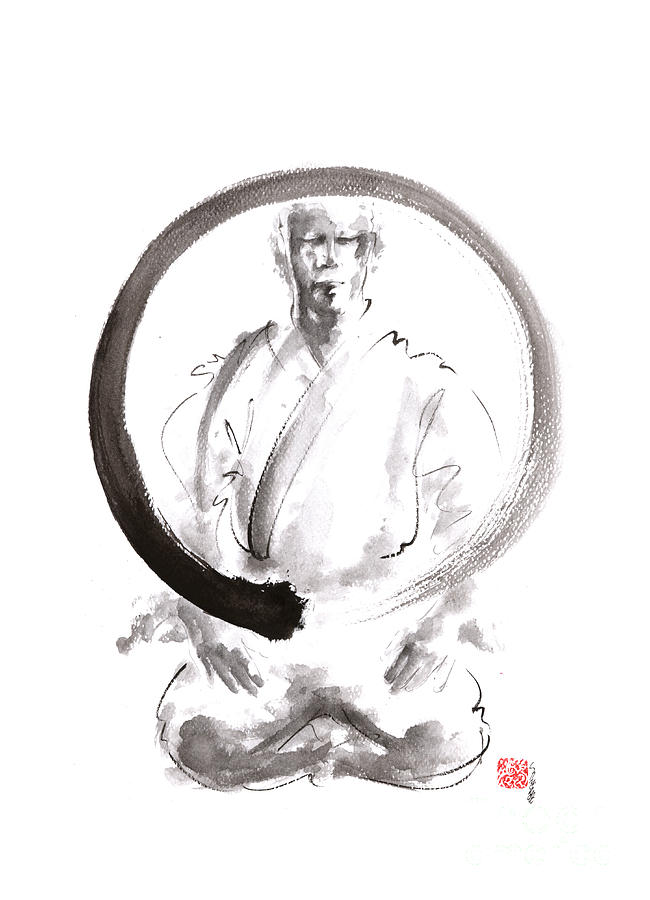
El círculo es la figura distintiva del Aikido, ya sea como ondas o espirales, el círculo está siempre presente y, cuanto más perfecta su ejecución, tanto mejor la técnica. El movimiento circular carece de aristas, de interrupciones. La energía fluye  libremente. Pero en ocasiones perseguimos el círculo solo a través de la circunferencia y nos olvidamos de sus otros dos componentes fundamentales: el radio y el centro. Sin la presencia de estos dos elementos la circunferencia se deshace. El radio es el camino de penetración para ocupar el centro. 


Resultado de imagen para aikido circulo

El radio es una recta hacia el centro y así debe ser la entrada (Irimi), directa, decidida. Y un centro firme en los desplazamientos del cuerpo (tai sabaki), manteniendo el eje vertical, que se vuelve el axis de la acción. El desequilibrio del adversario y la proyección surgen como consecuencia natural de este movimiento a partir de la postura y la actitud correcta.

El cuadrado se forma en las inmovilizaciones o retenciones (katame), con su base bien apoyada en el piso, las líneas de fuerza de sus diagonales cortando al Uke y su peso bajando por sus aristas de acuerdo a la ley de gravedad. 


Resultado de imagen para aikido

Estas tres representaciones geométricas presentan además muchas otras implicaciones.

O´Sensei Ueshiba recurría en ocasiones a las imágenes del triángulo, el círculo y el cuadrado para ilustrar conceptos ligados a los movimientos y los momentos del Aikido
Partiendo del punto y de la línea, que aún no tienen superficie, estas son las figuras básicas de la geometría que, cuando se les agrega volumen, se convierten en los cuerpos tridimensionales de la esfera, el cubo y la pirámide.


Las imágenes que describe O´Sensei son el producto de su esfuerzo de síntesis por transmitirnos su pensamiento y conocimiento del Aikido, a su vez, exige de nosotros un empeño equivalente por develar su significado. Este no es un propósito puramente enciclopédico o intelectual sino la vía para orientar nuestra práctica hacia el mejoramiento de la técnica y a incrementar mediante el entrenamiento asiduo nuestro poder y entendimiento, al mismo tiempo nos llevará a descubrir la esencia y el camino del Aikido.

Imagen relacionada

Sphere and cube

The sphere and the cube are two opposite forms from which the forms of all things arise. It can be said that they are the essential forms, the mother and the father of all forms.
The sphere and the cube manifest the cosmic principle of balance.

The sphere integrates those different forms from each other to interconnect them in unity. The true center of the circle or sphere is a point, but the point has no dimension and therefore escapes our perception and capacity for manifestation. It does not belong to our world, because in our world everything has extension, dimension, since the physical world is form, but the point belongs to another scale of being. It exists beyond physical reality, it is literally metaphysical.
The point symbolizes unity, totality, perfection. The point contains everything, only potentially, not manifested. From it are born the cube and the sphere, which are the ways in which the point is revealed. What at the point is still potentiality (without dimensions) takes shape through the cube and the sphere.

This geometry expresses the very essence of the universe.

A living and conscious universe, that thinks and breathes, made of light, of an electric nature (and therefore dual) and that is transformed all the time, following geometric patterns.

Consciousness extends its energy and information radially, from a point of omnipresent stillness to other points following the desire to shape your imagination.

Desire always comes first, it is what sets the spirit in motion.

The spirit directs energy and it condenses on matter. Our physical world is a creation of the spirit. In turn, the three-dimensional physical world serves as containment and limits the spirit, it is its vehicle.

The spherical waves of light are projected in the 3 dimensions of the cube in an infinity of frequencies and colors creating all forms and the illusion of physical reality.

Clarifying that this is only a description, the essence is unity, infinite consciousness and therefore indescribable.

Each created thing manifests according to its place in evolution, a part or a level of this consciousness. In reality it is about planes and frequencies, from the most physical, dense and low vibration levels to the most spiritual and subtle levels that vibrate at the highest frequency.
The movement of consciousness is born at a point of stillness and ends at another point of stillness, always looking for balance.

Consciousness jumps.

This movement is like the imagination of the Creator extending from one resting point to another to create its three-dimensional physical universe of length, width and thickness. This is how space is created, or the stage of life, where matter, time, change and movement arise.

The limits of your universe

The multiplication and apparent division of space into opposite electrical pressures or charges create the force of gravity and radiation, which make up the true dynamics of this changing universe.
The information radiates in the form of a sphere and travels like a spiraling wave. Opposite, it materializes in the form of a cube, hence the three dimensions of our physical world. The fourth dimension is time, which marks the duration and continuity of one conscious event to another.
Time is the measure of movement within the limits of the cube.

Our senses are designed to be handled within the cube (hence the three-dimensional reality of our daily life) and to capture pressure and movement, form, colors and a multitude of external and internal stimuli. In other words, they capture the imbalance.

To be able to perceive the other part of the cycle, which is the deepest part, the one that is not "seen", the root of things; we must transcend the senses and the ordinary mind. In this way you can go beyond the limits of the cube (from our usual material reality) and expand the dimensions of your consciousness.

The form of the world you perceive is the form of your consciousness. Time as you perceive it is the movement of your consciousness. The size and dimensions of your universe are those of your consciousness.

Your conscience shapes reality

The physical body, as a crystallization of cosmic matter and essence, trains itself in the path of human life to become one with the Universe and to accumulate its miraculous energy ("the subtle spirit").
In addition, human beings must have as their main objective of life, the great law of Heaven and Earth, which is in the creative unfolding of the Universe, and also to protect and purify this world.
In this search, you must first transcend the ordinary spirit, then polish and purify the vitality of the "nen" itself (feelings and thoughts), and with a single purpose pursue the unification of mind and body.

Aikido is the path of harmony. This harmony is the expression of universal laws. These laws are nothing other than knowledge of the structure and dynamics of the universe.

In Aikido we train ourselves to follow these laws and understand this structure, which is in turn the form and dynamics in which one is constituted as an individual, or perhaps it would be more accurate to say, the way in which one must build oneself physically and mentally to reach an ideal state both at martial level and in life.


 We are spirit and we are matter, and although both states share the same origin, they have different modalities.

Ichirei Shikon Sangen hachiriki

It means: One spirit, four consciences, three origins, eight powers.

The first section, "Ichirei Shikon" ("One Spirit, Four Souls or Concerts"), is the structure of the spirit world.

In Shintoist cosmology, humans have a spirit and four souls: the turbulent (aramitama), the quiet (nigimitama), the happy (sakimitama) and the wonderful (kushimitama). "Naohinomitama" is the spirit that acts as a kind of container for the four souls.

The second section, "Sangen hachiriki" ("Three Origins, Eight Powers"), is the structure of the physical world, the physical self and the methodology of physical training in Aikido.

"Sangen" ("Three Origins"), are the three basic elements of the universe - the sky, the human being and the earth, represented by the circle, the triangle and the square, the soft, the flowing and the hard.

In the structure of the "Hachiriki" Universe, or 8 powers or forces, according to Master Ueshiba, correspond to an active force, a still force, a traction force, a relaxation force, a division force, a combination force, a dissolution force and a crystallization or materialization force.

They are 4 pairs of complementary opposites that cyclically and rhythmically shape the physical universe.

Movement - Stillness
Materialization - Dissolution
Tension - Relaxation
Combination - Division


Martial arts were born in the form of the square, the circle and the triangle (and hence all other forms).
Thus the triangle symbolizes the impulse, the beginning of the movement, the energy projection.

The circle refers to movement, continuity, infinity.

The square represents the static, the solid, the stable, the material.

The triangular posture of the kamae (guard), provides at the same time as stability, the possibility of moving in all directions, either forward, backward, changing front by rotating the hip without shifting the feet (kaiten) or moving them towards forward or backward (Tenkan). The shape of the tetrahedron or pyramid allows us to move in four and eight directions.

The circle is the distinctive figure of Aikido, whether as waves or spirals, the circle is always present and, the more perfect its execution, the better the technique. The circular movement lacks edges, interruptions. Energy flows freely. But sometimes we chase the circle only through the circumference and forget its other two fundamental components: the radius and the center. Without the presence of these two elements the circumference is undone. The radius is the path of penetration to occupy the center.

The radius is a straight to the center and so must be the entrance (Irimi), direct, determined. And a firm center in the displacements of the body (tai sabaki), maintaining the vertical axis, which becomes the axis of the action. The imbalance of the adversary and the projection arise as a natural consequence of this movement from the correct posture and attitude.

The square is formed in the immobilizations or retentions (katame), with its base well supported on the floor, the lines of force of its diagonals cutting the Uke and its weight going down its edges according to the law of gravity.

These three geometric representations also have many other implications.

O'Sensei Ueshiba sometimes used the images of the triangle, the circle and the square to illustrate concepts linked to the movements and moments of Aikido.

Starting from the point and the line, which still have no surface, these are the basic figures of geometry that, when volume is added, become the three-dimensional bodies of the sphere, the cube and the pyramid.

These three geometric representations also have many other implications.

O'Sensei Ueshiba sometimes used the images of the triangle, the circle and the square to illustrate concepts linked to the movements and moments of Aikido.
Starting from the point and the line, which still have no surface, these are the basic figures of geometry that, when volume is added, become the three-dimensional bodies of the sphere, the cube and the pyramid.

The images that O'Sensei describes are the product of his synthesis effort to transmit his thoughts and knowledge of Aikido, in turn, demands from us an equivalent effort to unveil its meaning. This is not a purely encyclopedic or intellectual purpose but the way to guide our practice towards the improvement of the technique and to increase by regular training our power and understanding, at the same time will lead us to discover the essence and the path of Aikido.